
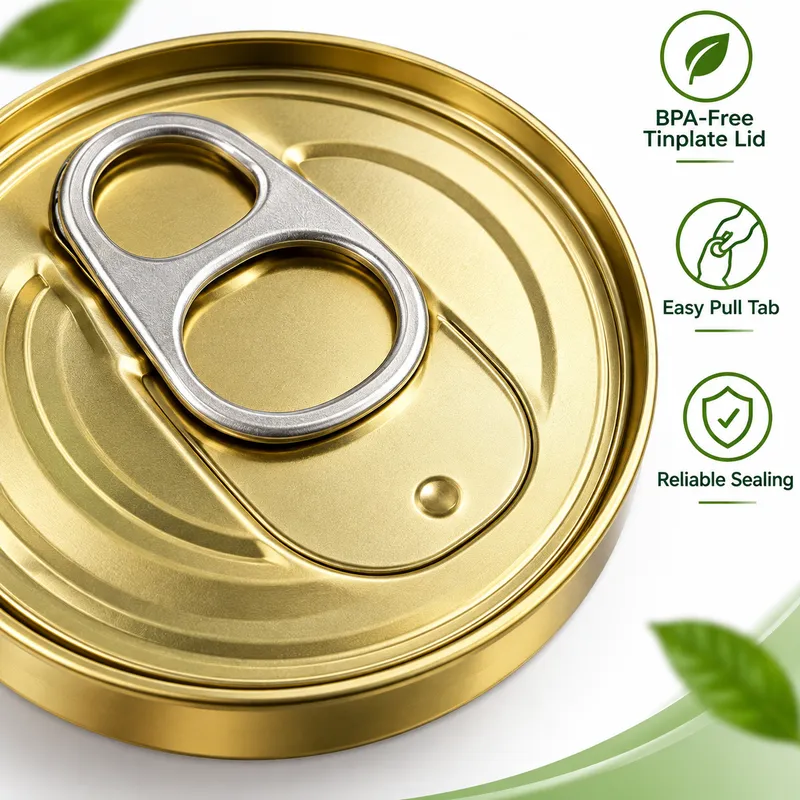
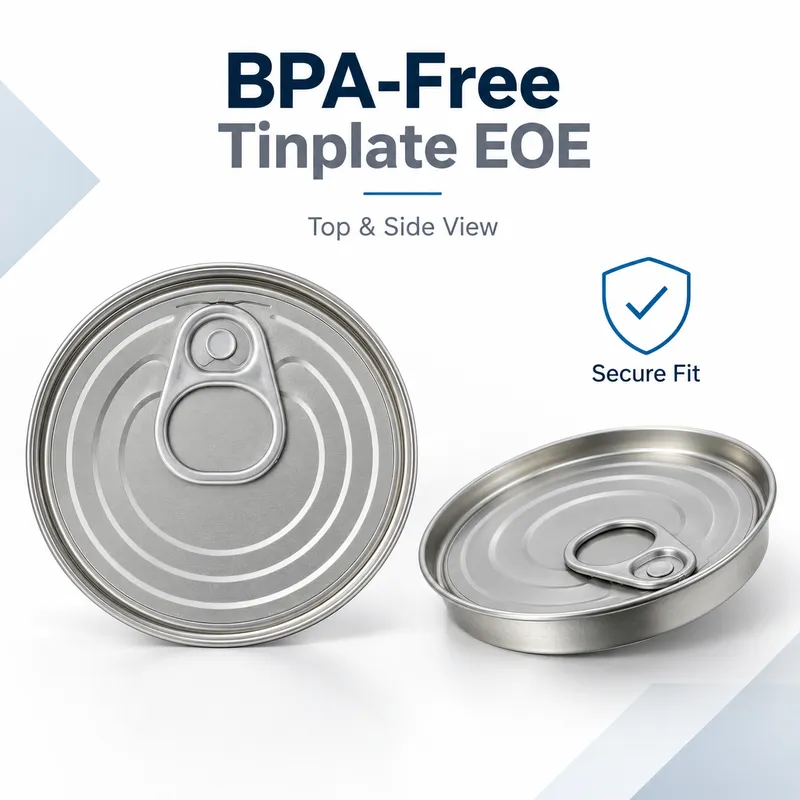
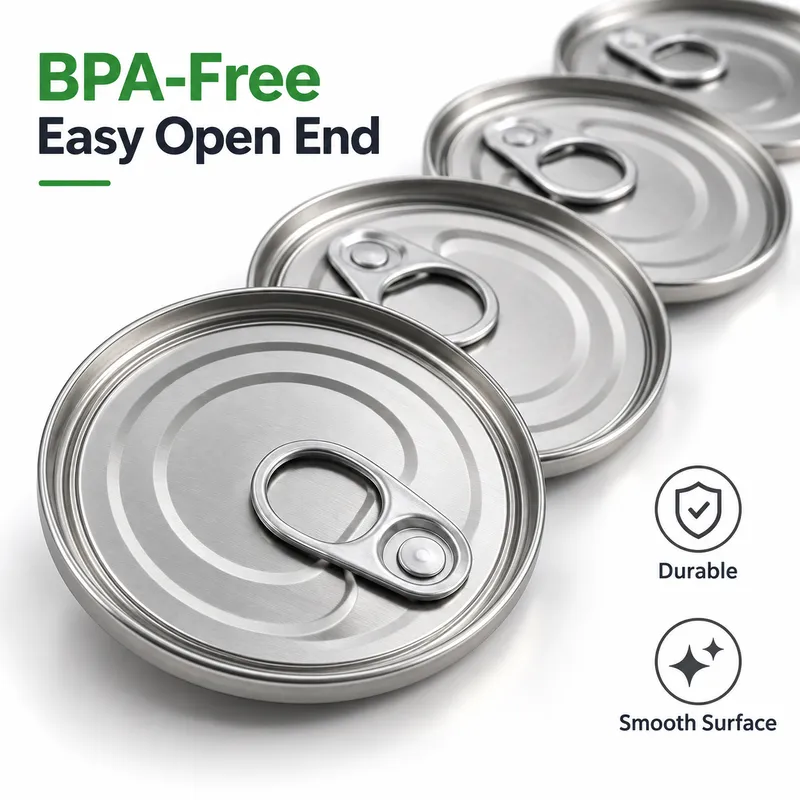
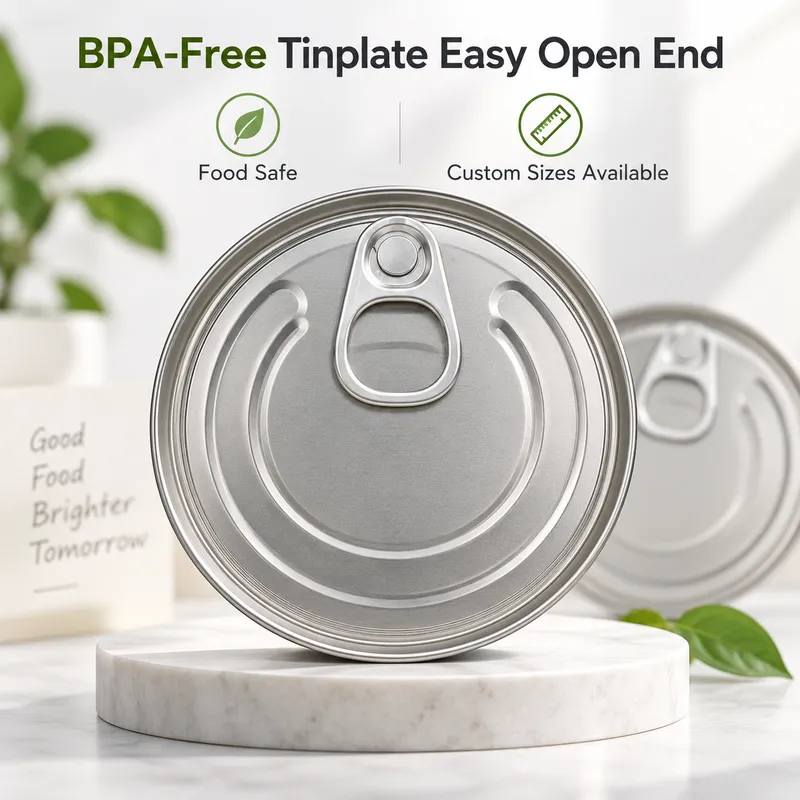
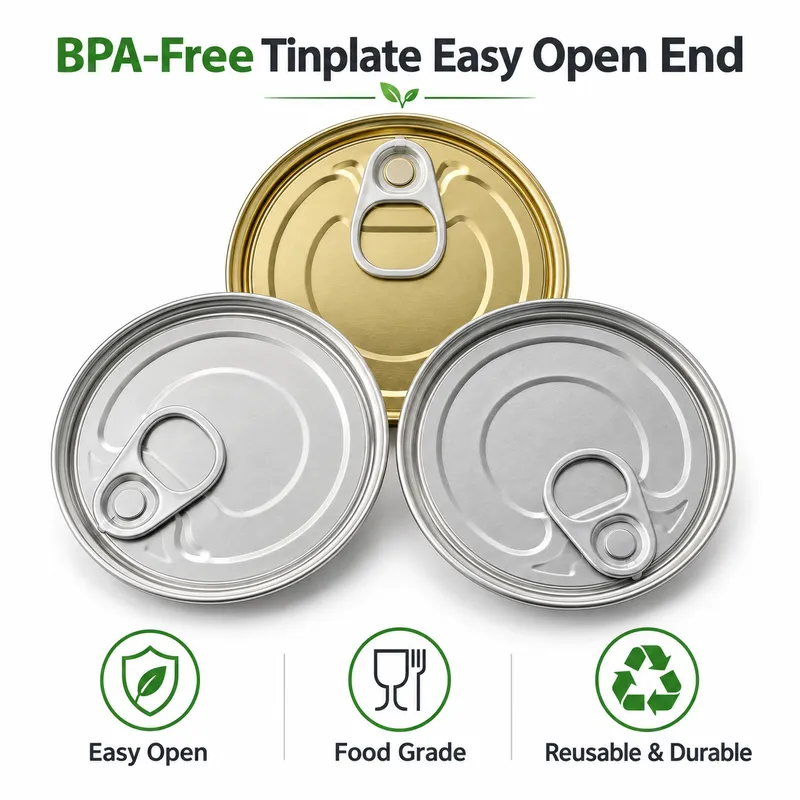
BPA-NI Coating System – Food-contact lacquer selected without intentionally using BPA according to the agreed coating specification.
Food Can Easy Opening – Scored panel and pull-tab structure for convenient can opening.
Custom EOE Specifications – Diameter, temper, coating, compound and end structure matched to the can system.
Controlled Coating Process – Coating, curing, line cleaning and lot traceability managed during production.
Complete Export Documents – MTC, COO, test documentation and complete commercial and shipping documents available.
BPA Free Easy Open End is a food-can closure manufactured from tinplate and finished with a food-contact coating system selected according to the customer's BPA requirements, filling product, retort process and can-seaming specification.
The product combines several functional elements: a metal end shell, controlled score line, pull tab, rivet structure, sealing compound and internal and external protective coatings. These components must work together to provide easy opening while maintaining container integrity before use.
Henan GDD supplies Easy Open Ends for canned vegetables, beans, fruit, tomato products, seafood, meat and other shelf-stable foods. Size, tinplate temper, end geometry, lacquer, sealing compound and printing can be reviewed according to the customer's existing can body and seaming equipment.
For BPA-sensitive projects, the coating specification should be confirmed before production. We distinguish between BPA-NI systems, where BPA is not intentionally used in the coating formulation, and a finished-product BPA-free claim that may require analytical confirmation according to the agreed test method and detection limit.
| Item | Specification |
|---|---|
| Product Name | BPA Free Easy Open End / BPA-NI Tinplate EOE |
| Base Material | Electrolytic Tinplate / ETP / SPTE |
| Common Temper | T4, T5, DR8, DR9 or Customized According to End Design |
| Thickness | Selected According to Diameter, Temper, Score Design and End Structure |
| Common End Series | 200, 202, 209, 211, 300, 307, 401, 502, 603 Series and Other Sizes Subject to Tooling Confirmation |
| End Type | Full Aperture / Selected Partial Aperture / Customized Easy Open Structure |
| Opening System | Ring Pull Tab with Controlled Score Line |
| Food-contact Coating | BPA-NI / BPA-free Coating System According to Agreed Product Specification and Test Scope |
| Internal Lacquer | Selected According to Food Chemistry, Acidity, Sulfur, Salt, Oil and Retort Conditions |
| External Finish | Clear / Gold / White / Printed / Customized Protective Coating |
| Sealing Compound | Food-contact Sealing Compound Selected According to Can and Processing Requirements |
| Pull Tab | Tinplate / Aluminum or Customized According to End Design |
| Surface | Natural Tinplate, Lacquered, Gold, White, Printed or Customized |
| Applications | Vegetables, Beans, Fruit, Tomato Products, Tuna, Sardines, Meat and Other Canned Foods |
| Processing Compatibility | Pasteurization / Retort / Sterilization Conditions Subject to Food, Lacquer and End Specification |
| Quality Control | Dimensions, Score, Tab, Rivet, Coating, Compound, Opening Performance, Surface and Packing Inspection |
| Testing | BPA / Migration / Extractives or Other Food-contact Testing According to Agreed Market, Product and Report Scope |
| Documentation | MTC, Coating Documentation, Certificate of Origin, Third-party Test Documentation Where Applicable, Export License Where Required and Shipping Documents |
| Packing | PE Bag / Protective Sleeve / Carton / Pallet / Seaworthy Export Packing |
| Trade Terms | EXW, FOB, CFR, CIF |
Final diameter, tinplate thickness, temper, score geometry, tab structure, coating, sealing compound and seaming specification must be matched to the customer's can body, filling product and processing conditions. Existing end drawings, can samples or current specifications are recommended for replacement projects.
BPA stands for Bisphenol A, an industrial chemical historically used as a building block in certain polymer and epoxy-resin systems.
In metal food packaging, the steel itself is not normally the main BPA concern. The issue is associated primarily with certain varnishes, lacquers, coatings, adhesives or related food-contact materials that may use BPA-based chemistry.
This distinction is important. A tinplate sheet can contain no intentional BPA in the metallic substrate while the finished can end can still involve a BPA-related coating if the lacquer formulation uses that chemistry.
Traditional epoxy-type coating systems became widely used in metal packaging because they could provide strong adhesion to metal, chemical resistance, processing resistance and protection between food and the metal substrate.
Food cans may undergo forming, seaming, sterilization, long storage and contact with acidic, salty, oily or sulfur-containing foods. The internal coating therefore needs to perform under demanding conditions.
BPA became relevant because certain epoxy-resin systems historically used BPA-related chemistry as part of resin manufacture.
Easy Open Ends form part of the food-contact packaging system. The internal surface can come into direct or indirect contact with the packaged food depending on the can design and filling conditions.
Customers therefore increasingly specify BPA-NI or BPA-free coating systems according to destination-market regulations, retailer requirements, brand policies and internal packaging standards.
For manufacturers supplying multiple countries, specifying the coating system clearly also reduces the risk of using an end designed for one market in a different regulatory environment.
These two expressions are often used interchangeably in commercial discussions, but technically they should be handled carefully.
BPA-NI generally means Bisphenol A is not intentionally used in the formulation or manufacturing specification of the relevant coating system.
A finished-product claim of "BPA Free" may also require analytical testing, a defined test method and a stated detection or quantification limit depending on the buyer, destination market and contract.
Henan GDD therefore recommends defining the required claim before production: BPA-NI, BPA not intentionally added, or analytical BPA-free compliance according to a specific test method.
Producing a BPA-sensitive Easy Open End requires more than changing the label on the finished carton. The coating system and manufacturing controls must be considered before metal forming begins.
The first step is selecting a lacquer system whose formulation is declared by the relevant coating supplier as BPA-NI or otherwise suitable for the agreed BPA requirement.
Coating selection also considers the intended food, sterilization conditions and end-forming process. A coating that is suitable for dry food packaging is not automatically suitable for acidic tomato products, sulfur-containing foods or high-temperature retort processing.
Coating batch identification and available supplier documentation are reviewed according to the project requirements before production.
This creates traceability between the coating material, production batch and finished Easy Open Ends.
Where production equipment is also used for other coating systems, suitable cleaning and production-change procedures are important for reducing unintended carryover between products.
Coating containers, mixing equipment and production records should remain clearly identified during the BPA-NI production run.
The selected lacquer is applied at the required coating weight to provide continuous coverage across the food-contact surface.
Coating uniformity matters because insufficient film coverage can affect corrosion protection even when the coating chemistry itself meets the BPA requirement.
The coated tinplate passes through a controlled curing process according to the coating specification.
Correct curing allows the coating to develop the adhesion, hardness and chemical resistance required for downstream stamping and food processing.
After coating, the material undergoes blanking, shell forming, curling and other operations required to produce the end.
The coating must remain sufficiently intact through deformation around the countersink, panel, curl and other formed areas.
The opening panel is precisely scored and the pull tab is attached through the rivet structure.
Score residual thickness, tab geometry and rivet integrity must be controlled so that the end opens reliably without compromising pre-opening strength.
Food-contact sealing compound is applied to the curl area according to the required can and seaming specification.
The sealing compound itself should also be reviewed as part of the complete food-contact packaging system where BPA requirements apply.
Production identification connects finished ends with relevant raw-material, coating and manufacturing records.
Traceability becomes especially important when customers require regulatory documentation or third-party testing for specific production lots.
Where required, finished products or representative materials can be submitted for third-party testing according to the applicable market, agreed test method and report scope.
Applying a lacquer to tinplate does not automatically mean BPA is present.
BPA content depends primarily on the chemistry of the selected coating system and other relevant food-contact materials.
By selecting a BPA-NI coating system from the start and controlling coating identification, production changeover, application and curing, the protective paint layer can be applied without intentionally introducing BPA through the lacquer formulation.
Where the finished product must carry a defined BPA-free claim, analytical confirmation should be performed according to the buyer's required test method and acceptance limit.
Removing BPA-related chemistry does not mean the Easy Open End should be supplied as bare tinplate for every food application.
The protective lacquer still performs important functions by separating the food from the metal surface and helping the end resist corrosion during filling, sterilization and storage.
The technical objective is therefore not to eliminate coating, but to use a suitable food-contact coating system that satisfies the agreed BPA requirement while maintaining the required packaging performance.
There is no single internal lacquer that is automatically suitable for every canned food.
Tomato paste and fruit can be acidic. Seafood and meat may involve sulfur compounds, salt, oil or sauces. Vegetables and beans can also have different processing and storage conditions.
The selected coating should therefore be reviewed together with filling composition, pH, salt content, oil content, sulfur risk, sterilization temperature and expected shelf life.
Tomato paste, tomato sauce and related products require careful packaging selection because their acidity can create a demanding environment for the internal coating.
A BPA-NI Easy Open End intended for tomato products should therefore use an internal lacquer system selected for the actual food and thermal process rather than simply using a generic decorative coating.
Customers can provide the filling product, retort conditions, can size and current end specification for review.
Seafood products can involve oil, brine, salt and sulfur-related packaging challenges depending on the recipe.
The Easy Open End coating needs to be matched with the product formulation and sterilization process.
End diameter, score design and opening force should also correspond to the customer's approved can format.
Beans, vegetables and similar shelf-stable products are commonly packed in three-piece cans using Easy Open Ends.
The required coating should be selected according to brine, sauce, sulfur potential and thermal processing conditions.
Buyers changing from a conventional coating to a BPA-NI system should complete appropriate package compatibility and production-line validation before commercial filling.
A Full Aperture Easy Open End is designed so that a large portion of the center panel can be removed by pulling the tab.
This structure is widely used for solid and semi-solid foods because it provides broad access to the contents.
The exact panel geometry, score profile, tab structure and opening performance must be matched to the end diameter and filling application.
The score line is one of the most critical features of an Easy Open End.
It must be thin enough to allow controlled tearing when the tab is pulled, but strong enough to maintain integrity during filling, retorting, stacking, transportation and storage.
For this reason, EOE production requires controlled score residual thickness rather than simply cutting a groove into the lid surface.
The pull tab transfers the user's force to the scored panel.
Rivet geometry, tab thickness, tab profile and panel relationship all influence opening behavior.
A change in tinplate temper or thickness can affect this system, which is why EOE raw material should not be changed independently without considering the complete end design.
Easy Open Ends require a controlled balance between strength and formability.
T4, T5 and double-reduced materials such as DR8 or DR9 can be considered according to end structure and manufacturing process.
A higher-strength material may allow gauge optimization in an engineered end design, but it can also change forming and opening behavior.
Temper, thickness and score geometry should therefore be confirmed together.
An Easy Open End cannot be selected only by its nominal diameter.
Curl geometry, countersink, end thickness, sealing compound and can flange dimensions all influence the final double seam.
When replacing an existing supplier, buyers should provide the current EOE drawing, can-body dimensions, seam specification or physical samples where possible.
Trial seaming and seam teardown evaluation are recommended before full commercial production with a new end specification.
Many shelf-stable canned foods undergo thermal processing after sealing.
During retort, the Easy Open End can be exposed to heat, internal pressure, moisture and food chemistry simultaneously.
The tinplate temper, coating, compound and end geometry should therefore be validated under the actual or representative thermal process rather than evaluated only at room temperature.
BPA status and food compatibility are related but separate questions.
A coating can meet the customer's BPA requirement but still be unsuitable for a particular highly acidic, sulfur-containing or high-temperature processed food.
Buyers should therefore evaluate both chemical compliance and packaging performance before approving an Easy Open End for a new filling product.
Relevant third-party food-contact test documentation can be provided according to the corresponding product, coating system and report scope.
Where applicable, documentation against relevant FDA 21 CFR 175.300 coating requirements can be supplied according to the actual test report and product scope.
Such documentation should be understood as third-party testing or assessment against referenced requirements. It should not be described as an FDA-issued product certification.
Additional BPA-specific or migration testing can be arranged where required by the buyer or destination market.
A typical tomato-paste can producer changing to a BPA-NI end first confirms end diameter, internal lacquer, retort conditions and existing seaming parameters.
The customer does not evaluate the coating only by the words "BPA Free." Acid resistance, coating integrity after end forming and performance after thermal processing are also reviewed.
Trial cans can then be used to confirm seam compatibility and package performance before mass production.
A tuna or sardine producer may require a full-aperture Easy Open End with BPA-NI internal coating for oil or brine-packed products.
The technical review includes food chemistry, end diameter, score opening performance, retort cycle and compound compatibility.
When replacing an existing end, the current sample or drawing provides a useful reference for maintaining seaming-line compatibility.
A three-piece can manufacturer may use BPA-sensitive EOEs across several canned vegetable products.
Rather than assuming one lacquer is suitable for every filling, the product range is reviewed according to brine, sauce, sulfur potential and thermal process.
This helps reduce the risk of selecting a coating that meets a chemical requirement but performs poorly with the actual packed food.
A distributor changing from a conventional coating system to BPA-NI material may supply existing end drawings, can sizes and customer specifications.
The replacement product is then matched by size, temper, score design, coating, compound and seaming requirements rather than simply replacing one lid with another of the same nominal diameter.
These examples describe typical procurement and application workflows. Customer names, confidential pricing and proprietary product specifications are not published without authorization.
Once an Easy Open End has been approved for a filling line, repeat customers normally focus strongly on consistency.
Common control points include end dimensions, tinplate thickness, coating appearance, compound distribution, score performance, tab attachment, opening force, packing condition and lot traceability.
For BPA-sensitive products, consistent coating identification and agreed documentation are also important parts of repeat-order control.
BPA Free Easy Open End inspection can include dimensional measurement, curl condition, countersink, score quality, pull-tab attachment, rivet structure, surface coating, sealing compound and overall appearance.
Opening-performance checks help confirm that the tab initiates the score and the panel opens as intended.
Production identification supports traceability between finished ends and corresponding tinplate, coating and manufacturing records.
Product photographs, inspection photographs, packing photographs and loading photographs can be provided according to customer requirements.
For a BPA-sensitive product, coating traceability is an important part of supply documentation.
Production records can connect the relevant coating batch or approved coating system with the finished Easy Open End production lot according to the manufacturing documentation available.
Customers requiring specific coating declarations, BPA statements or laboratory documentation should confirm those requirements before production.
Tinplate raw material can be supported by corresponding mill documentation according to the order and supply route.
Depending on the supplied material, the MTC can include grade, thickness, temper, tin coating and production identification.
The MTC relates primarily to the metal substrate. Food-contact coating compliance should be supported separately through relevant coating or test documentation according to the project scope.
Independent inspection and laboratory testing can be arranged according to the agreed contract scope.
Inspection can cover dimensions, product appearance, coating identification, packing, quantity and documentation.
BPA, migration, extractives or other food-contact tests can also be discussed where required.
Test method, food simulant where applicable, temperature, duration, detection limit and acceptance criteria should be agreed before testing so that the resulting report matches the customer's compliance purpose.
Henan GDD supports international Easy Open End shipments with technical, commercial and customs documentation prepared according to order and destination requirements.
Available documentation can include MTC, Certificate of Origin, coating documentation, third-party test reports where applicable, export license where required, commercial invoice, packing list, bill of lading and customs declaration documents.
Product photographs, inspection photographs, packing photographs and container-loading photographs can also be supplied according to agreed requirements.
Destination-specific food-contact declarations, conformity documentation, legalization or other special requirements should be confirmed before order placement.
Easy Open Ends are precision-formed packaging components and must be protected against deformation, scratches, contamination and moisture during transportation.
Ends can be packed in protective sleeves or bags and placed into reinforced cartons before palletizing.
Internal packing should keep stacks aligned so that curls, tabs and formed panels are not damaged during handling.
Export labels and shipping marks can include product size, lot number, quantity and other agreed identification information.
Henan GDD supplies tinplate raw materials and finished metal packaging products to international can makers, food processors, packaging distributors and closure manufacturers.
For BPA Free Easy Open End projects, we can review the metal substrate, coating system, end structure, sealing compound, can specification and food application together rather than treating the lid as a standalone metal component.
Existing EOE drawings, samples, seam specifications and current coating requirements can be reviewed before quotation to reduce replacement risk.
Relevant third-party food-contact test documentation can be provided according to the applicable product and report scope. BPA-specific testing can also be discussed according to customer requirements.
MTC, Certificate of Origin, export license where applicable and complete commercial and shipping documentation can be provided according to contract requirements.
BPA, or Bisphenol A, is a chemical historically used in certain polymer and epoxy-resin systems, including some coating technologies used in metal food packaging.
BPA concerns in metal food packaging are primarily associated with relevant organic coatings, lacquers and related food-contact materials rather than the steel and metallic tin substrate itself.
BPA-NI generally means BPA is not intentionally used in the relevant formulation or manufacturing specification. A specific finished-product BPA-free claim can additionally require analytical testing according to an agreed method and detection limit.
The key is to use a coating system selected without intentionally using BPA, maintain clear material identification, apply suitable line-cleaning and production controls, cure the coating correctly and verify the finished product according to the agreed test scope where required.
No. Food-can ends still normally require an appropriate protective coating. The objective is to use a suitable BPA-NI or agreed BPA-free coating system rather than eliminate the protective lacquer itself.
Not necessarily. The coating should also be suitable for the filling product, acidity, sulfur, salt, oil, thermal process and expected shelf life.
Third-party BPA or other food-contact testing can be discussed according to the required market, test method, detection limit and product scope.
Relevant third-party test documentation against applicable FDA 21 CFR 175.300 coating requirements can be provided according to the corresponding product and report scope. This should not be interpreted as an FDA-issued product certification.
Yes. MTC, Certificate of Origin, export license where applicable, commercial invoice, packing list, bill of lading and other agreed documents can be provided.
Please provide the end diameter or series, can-body specification, filling product, required tinplate temper, coating requirement, retort conditions, sealing specification, quantity, destination market, destination port and required compliance documents.
Looking for BPA Free Easy Open Ends for canned vegetables, beans, fruit, tomato products, seafood, meat or other shelf-stable foods?
Send Henan GDD your required EOE size, can-body specification, filling product, retort conditions, coating requirement, quantity, destination market, destination port and required compliance documentation.
If you are replacing an existing Easy Open End supplier, you can also send your current EOE drawing, physical sample, seam specification, coating requirement or test report. Matching the complete end and food-contact system is generally more reliable than selecting a replacement based only on nominal lid diameter.
